

American Idols
The Halftime Show, and the reaction it provoked, is a microcosm of what America is, and what it aspires to be.

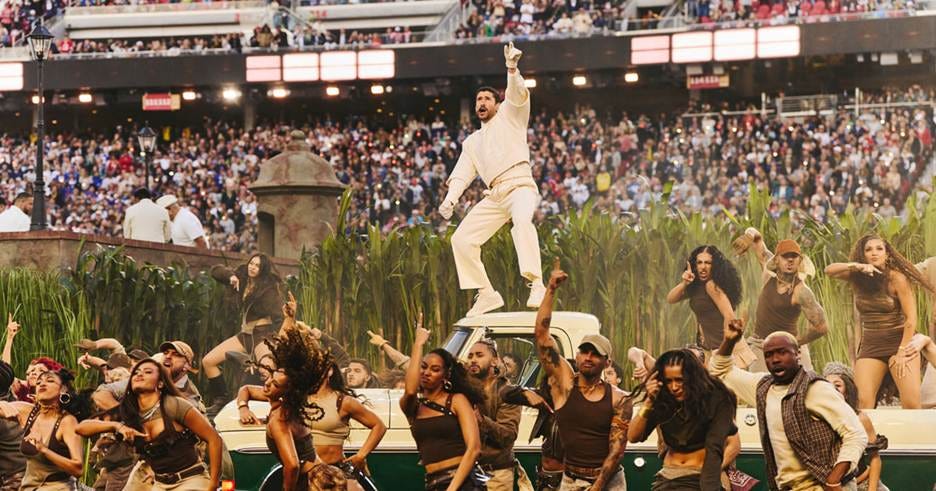
Image Credit: Apple-Music-Super-Bowl-LX-Halftime-Show-hero-lp.jpg.og.jpg (1200×630)

Dear Friends,
Some weeks, I bite off more than I can chew. Last week was one of those weeks. Though I did not watch the Superbowl or the halftime show (or the alternative Halftime show, sponsored by Turning Point USA and broadcast on TBN), immediately in the aftermath, my social media feeds were flooded with hot takes about it. Since this was the first time that the Halftime show has been broadcast entirely in Spanish, several people asked me what my take on it was, and if the salacious rumors about the contents of its lyrics were true. I thought it would be the work of an hour or two to translate the lyrics, provide some context for them, and give a brief assessment.
I was wrong.
I am now two weeks late, and with the news cycle moving as fast as it does these days, a thirteen minute show two weeks ago probably is (at most) a distant memory. What’s more, what I have is far too long for an email. So, instead of flooding your inbox with a full Spanish translation and analysis of the lyrics of the Superbowl halftime show, if you (or someone you know) has any interest in the subject, please check out my full-length article here.
My TLDR summary of the Superbowl show controversy is that the show was neither as good as its proponents claimed, nor as bad as its detractors claimed. A friend of ours, who was at the Superbowl, told me that the show “sucked”—not because she disliked the message, but because it seemed design to marginalize those who weren’t in the VIP seats. The entire production was made for the television audience rather than the live audience, with the result that unless you were in the high-priced area of the stadium (as opposed to the “low-priced” $6,000 seats of the plebs), you couldn’t even see the performers, and unless you spoke Puerto Rican Spanish, you couldn’t understand them either. Her experience encapsulates for me what didn’t work about the show as a show.
But of course, it was never about the show. It was about the symbol. To have a Superbowl halftime show performed entirely in Spanish by an American citizen whose first language is Spanish from an American territory that is not allowed to vote in Federal elections, highlights the tensions and uncertainties about what it means to be an “American.” Even the word “American” itself is problematic when used exclusively to refer to residents of the United States, as Bad Bunny’s benediction highlighted: technically, a resident of Argentina is just as “American” as a resident of the United States. The kind of national assumption that says that we are the real Americans is coded into our very language: While most other languages have separate words to distinguish between being a resident of the United States versus a resident of the Americas (for example, in Spanish estadounidense vs. americano), we don’t even have the words to visualize an America without assuming that it is “Americanism” is defined by English-speaking (and, unless otherwise qualified, white) citizens of the United States. Particularly in a period in which many Spanish-speaking Americans—including legal residents and even full citizens—are frightened to leave their houses for fear of being abducted and incarcerated by ICE, the show was a necessary and timely reminder that “America” is a lot more diverse than white nationalists would like to believe, and a lot more enmeshed in the larger world than isolationists would like to admit.
In my opinion, it was a timely and necessary message delivered in an imperfect package.
I tend to be more of a prude than the average, so I didn’t particularly appreciate the suggestive dancing or the libertine philosophy that both the choreography and lyrics communicated. While it is true that the lyrics of the original songs were edited to be suitable for national broadcast (so, if you were scandalized by X-rated lyrics allegedly from the show, they almost certainly were not actually from the show), there was plenty of suggestive material left in both the lyrics and the choreography to make me very uncomfortable about watching the show with my hypothetical adoptive Abuelita. When we were discussing the halftime show with some friends at church, they said that their nine-year-old daughter, after watching, asked them, “Why was he grabbing his penis so much?” Since I am still trying to convince my four-year-old to avoid grabbing or exposing his own penis in public, this is not an example that I want him to follow or a conversation I am particularly eager to have.
That said, this unabashed celebration and even deification of sexuality and sexual fulfilment is the norm for American pop culture. What’s more, it has been for generations. When reading The Looming Tower: The Road to 9/11, I was surprised to learn that Sayyid Qutb—a soft-spoken, well-educated Egyptian who later became a driving force behind the founding of the Muslim Brotherhood and one of the forerunners of contemporary jihadism—was radicalized in part by his time in the United States which, at the same time as it was adding the words under God” to its pledge of allegiance in an effort to differentiate itself from the godless USSR, was in practical terms devoting itself to the worship of Mammon and Venus. Though nostalgists of the MAGA ilk like to portray the 1950s as a time of clean-cut boy scouts and beaming Stepford wives, Qutb saw an utterly secular and hedonist society that had lost its spiritual moorings and whose piety, for most, ran (at most) skin-deep. Faced with the alternative between a comfortable life in this spiritual wasteland and intentional jihad—both in the internal sense of struggle for spiritual purification, and the external sense of fighting to impose Islamic values upon the world—he opted for the latter, resulting in his execution in 1966 by Nasser’s government in Egypt.
What Qutb saw then has only become clearer now. Turn on any secular radio station (and even most Christian radio stations), watch popular shows or movies, read popular books, and it is obvious that the practical theology of most Americans (if not the confessed theology) is the worship of Mammon and Venus: the belief that the well-lived human life depends on sexual fulfilment and material acquisition. The twerking dancers in Bad Bunny’s show were simply acting on a theology that the vast majority of Americans have already embraced.
Does that mean that Christians cannot in any way participate in pop culture? Are we morally obligated to boycott Bad Bunny? I personally don’t think so. I think that the issue is analogous to the eating of meat sacrificed to idols in I Corinthians. Can one dance without embracing the gods glorified in the music one is dancing to? Perhaps. Conscience must determine. But when doing so, one must be very careful to remember that the idols that the meat was sacrificed to are, in fact, idols.