

Humility
The freedom of giving up on identifying as “special”

“And behold, there are some who are last that will be first and there are some who are first who will be last.” – Luke 13:30
Last week was spring break, and it was glorious. Of course, for homeschoolers, “spring break” is whatever you choose to make it, and we did not make much of ours. We didn’t have our co-op on Monday, but other than that, the routine continued as it usually does, with English and math work most days (although we did take Thursday and Friday off), gymnastics/swimming lessons, time with grandparents, playdates, science classes. The main “break” of spring break was simply the air itself: it felt like recreation to see the earth begin its annual ritual of re-creation.
Yet, as I watch the earth awaken from its long, wintery slumber, I feel doubly challenged and frustrated by my inability to awaken myself. I struggle to muster my forces in any productive direction. I wake up at a reasonable hour after what seems like it should have been a decent night’s sleep, and I feel like I can’t get up. Or worse I can, but I don’t. The condemning voice of Solomon echoes in the back of my consciousness: “A little sleep, a little slumber, a little folding of the hands to rest, and soon poverty shall come upon you as a robber, and want as an armed man.”
I go through phases with the seven deadly sins, but right now my principal adversary would appear to be sloth--ἀκηδία, in Greek—the kind of listlessness or spiritual melancholy that that struggles to find contentment and purpose in one’s circumstances and so struggles to find the motivation to undertake necessary tasks.
For me, the gap between what I feel I should be able to achieve and what I actually do achieve on a daily basis usually feels vast.
Most days bring a few limited but consistent victories: the kids get their English and math studies done. Something is prepared for dinner (even if it’s just leftovers). The kitchen is cleaned (though usually not before the kids are in bed). On particularly good days, I also manage to get the laundry done (though usually not folded and put away), the floor vacuumed/mopped, the main floor cleaned, the lawn mowed, and/or my bedroom cleaned. (I might get up to two or, on a very good day, three items from this list completed, but almost never more).
Then, I have my tertiary list of projects that should be done, and theoretically should be doable, but in practice never are. I’ve been meaning to clean out the guest room (where the guest bed has become a kind of elephant graveyard for homeless miscellany) for months. I’ve been meaning to update the family budget since Christmas. I have six months’ worth of books that I want to write reflections on. I have emails that I have literally been meaning to respond to for over a year.
None of these things would take that much time, and realistically, time is not the limiting factor (although it is a limiting factor); after all, I manage to waste hours every day between doomscrolling on my phone, or just in between the thousand tiny tasks that require minimal mental engagement, but just enough mental engagement to prevent real focus on anything else.
That is the limiting factor: focus. Mental discipline. Headspace. However you want to put it. If I could find a way to harness those “in-between” times and have sufficient focus to maximize mental acuity when the kids are finally down, I could be incredibly productive.
Of course, if physicists could perfect cold fusion, global energy problems could be solved; the trick in both cases is figuring out how to do it. It feels both frustrating and humbling to be faced with a set of challenges that seems so solvable, yet I am so consistently unable to solve it.
Yet perhaps that is part of the reason why God set me on this path (as I believe that He did): because my soul needed to learn humility.
As I’ve written before, one of my favorite parts of being a parent is rediscovering old books that I loved as a child, and few of those old books have aged better than the Chronicles of Narnia. While I enjoy them all, my favorite is probably The Horse and His Boy. In this story, Bree, a talking horse of Narnia captured as a foal and taken to work as a war-horse among the dumb horses of the great southern empire of Calormen, escapes and makes his way back home. Along the way, however, he discovers that he is not as brave or as clever as he had come to think from his years as a prized war-horse in the Calormene cavalry, and after a moment of particularly shameful cowardice, he decides he is not worthy to continue on to Narnia at all.
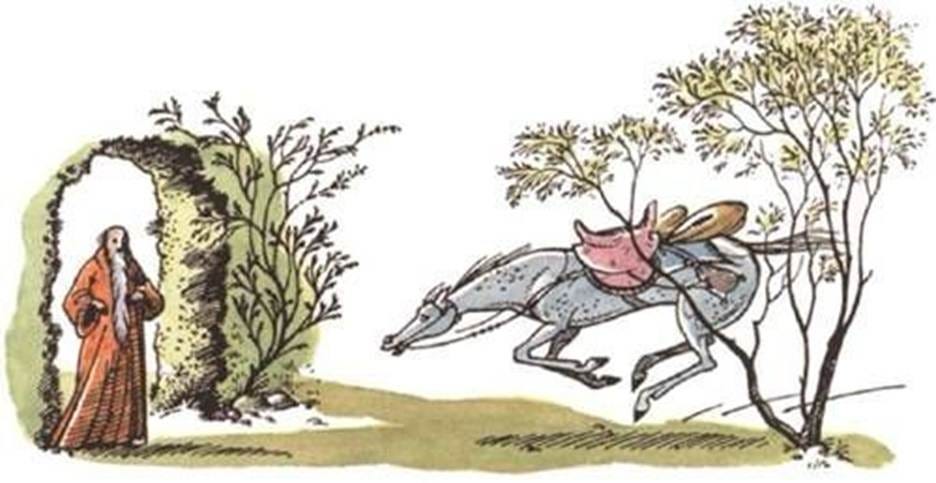
Image Credit: The Horse and His Boy: Bree racing toward the Hermit of the Southern March 2ca7c46ebc2e9295c671bcf629207f37.jpg (500×258)

At this point, the wise hermit of the southern march gives him some words of wisdom:
My good Horse, you’ve lost nothing but your self-conceit. No, no, cousin. Don’t put back your ears and shake your mane at me. If you are really so humbled as you sounded a minute ago, you must learn to listen to sense. You’re not quite the great Horse you had come to think, from living among poor dumb horses. Of course you were braver and cleverer than them. You could hardly help being that. It doesn’t follow that you’ll be anyone very special in Narnia. But as long as you know you’re nobody very special, you’ll be a very decent sort of Horse, on the whole, and taking one thing with another.
It is another CS Lewis-ism (though whether real or apocryphal I do not know) that “true humility does not consist in thinking less of yourself, but rather, in thinking of yourself less”: it is not so much self-abasement as self-forgetfulness. Whether this precise quote may be accurately attributed, I certainly think that its essence is true and consonant with the tenor of Lewis’ thought.
Nonetheless, these two are, at least at times, complementary rather than contradictory impulses: for me, it was necessary to learn to think less of myself before I could think of myself less. From about the ages of ten to twenty-two, I labored under the illusion of greatness. I was told I was destined for great things, and I was more successful in my undertakings than most of those I met. Consequently, like Bree, I thought myself something particularly exceptional. Indeed, my whole life and identity centered on this “giftedness,” and if I wasn’t the best, then I didn’t know who I was. Unlike Bree, I recognized this pride as a problem. However, I still didn’t have the tools to combat it: my view of humility was either to try to cultivate self-hatred, or else to try to convince myself of something (that I was not in fact smart or talented) which available evidence suggested was manifestly untrue: in other words, to believe a lie, knowing that it was a lie. Consequently, as long as I saw myself as “gifted”—not as an attribute, but as an identity—I was trapped. I was never able to forget myself because I always had to watch out for those who were more successful than I was. I had to be the best, and I didn’t know who I would be if I wasn’t.
That view died long and hard, beginning with the end of undergraduate school. However, eighteen years of failures and frustrations later, I can now forget myself (at least at times) because I know, based on a preponderance of empirical evidence, that I am nothing special. There is freedom in that realization.
Of course, this is not a safe place to rest, either. If before, I was under the illusion that I could do anything I wanted to, now, I often feel I cannot do anything at all, which makes it difficult to try. Of course, in true Christian humility, self-forgetfulness is just the first part: the goal is not to be emptied into a Zenlike mental vacuum, but to fill the void left by the ego with God. As John the Baptist said, “He must increase, and I must decrease” (John 3:30). This is where I have far more work to do. But still, I know that the words of Jesus in the Gospel are indeed “good news,” because they remind me that my identity was never about my place in line. And so, wherever I fall in the pecking order, whatever the fate of my giftedness, I will do the best that I can with the calling that I have received.
And that God loves you and me is where our value is. (But we forget)
And that you are the WORLD to your children, caring for them, their education and their needs both tenderly and fully is where your ministry is. (But we forget)
And that your gifted mind writes down these deep thoughts, giving God the Glory for Creation and Salvation, is where your service is. (But we forget)
Keep on keeping on, Michael. Many prayers are being answered as you just live your life. You are loved.
Michael this is so insightful and so self-revelatory. It is a journey that you are on and the journey is not done. I agree with everything that Caroline said.